

© 2026 by The Allied Report.

.png)
Shattering Our Own Foundation
The contemporary phenomenon known as "Christian Deconstruction" represents a systematic dismantling of orthodox faith under the guise of intellectual honesty and spiritual growth. The Berean Trail dives into a Biblical critique of Christian Deconstructionism and its roots and the inevitable end for those who abandon the sufficiency of Scripture.
BEREAN TRAIL • 05 FEBRUARY 2026

May 20, 2026 at 8:02:01 AM
UPDATED:
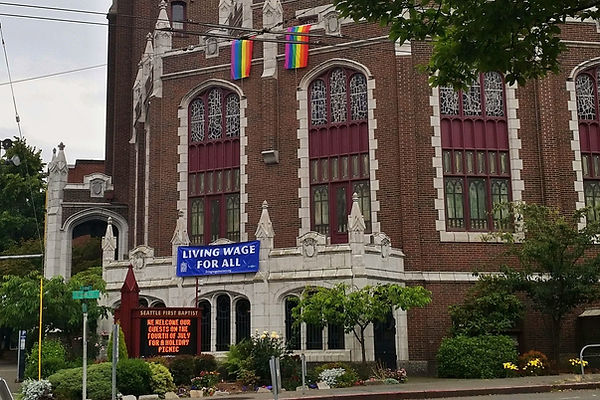
Seattle First Baptist in July of 2014 (Photo by Ben Ditzel)
The contemporary phenomenon known as "Christian Deconstruction" represents a systematic dismantling of orthodox faith under the guise of intellectual honesty and spiritual growth. To the Biblicist, however, this trend is not a neutral process of questioning; it is the modern manifestation of apostasy as described in the New Testament. When a follower of Christ begins to unravel their beliefs, the process typically starts with a subtle shift in authority, moving from the objective, inerrant Word of God to the subjective, shifting sands of human experience and cultural pressure. Perhaps it is a frustration with a body of believers. Maybe a close friend or relative abandoned the faith or embraced sin and, in order to remain close, inadvertent compromise creeps in. Or it could stem from a desire to simply be different due to social, political, religious, or rebellious motivations. This essay examines the doctrinal foundations, the progressive stages of descent, and the ultimate end resulting from deconstruction; the slow fade from a foundation in the absolute sufficiency of Scripture and the Lordship of Jesus Christ.
The Foundation of Authority
Where the subject knows it or not, the root of all deconstruction is a failure to uphold the doctrine of Biblical inerrancy and the sufficiency of Scripture. The Bible is not merely a collection of human insights or a guidebook for morality; it is the inspired, inerrant, and infallible Word of the Living God. When an individual views the Bible as a text that can be edited, adjusted to fit their desires, reinterpreted through a gnostic lens, or discarded in parts, they remove the only anchor capable of holding the soul against the tides of secularism.
It is important to note that deconstruction is essentially simply a new word for an old problem: unbelief. The Deconstructionist's movement is a rejection of the authority of God. If the Bible is sufficient for "all things that pertain to life and godliness" (2 Peter 1:3), then any push to deconstruct its clear teachings is an attempt to escape the accountability that the Word demands. The deconstructionist seeks a faith that does not require submission. He or she cannot abide the concept of Christ's Lordship, the fruit that results from all who are saved, or the truth that followers of Christ are also His joyful slaves (δοῦλος). However, true saving faith is characterized by the recognition of Christ as despotēs, the absolute Master who possesses supreme authority (2 Peter 2:1). To deny the Master’s right to rule through His Word is the very definition of Christian heresy.
Deconstruction by Way of Inclusivism
The descent into deconstruction often begins with inclusivism. This means is manifested when a so-called "Christian", perhaps a music artist, teacher, influencer, or average citizen, begins to value social and political alignment over doctrinal purity. The "seed that falls on rocky ground" (Matthew 13:5-6) lacks the depth of root required to withstand the heat of cultural conflict. Consequently, the follower’s passion for the things of faith begins to "wriggle out from under the authority of Scripture."
In this stage, the believer adopts an ecumenical worldview by holding unity and the social gospel in higher importance than Scripture, the true Gospel, and sound doctrine. They begin to justify a newly embraced inclusivism that blurs the lines between refined theology and progressive error. For example, in the realm of worship music, this is seen through failures in lyrical discernment. A songwriter may move from Scripture-saturated hymns to lyrics that suggest the Holy Spirit is a "gas or mist" to be invited into an "atmosphere," contradicting the Biblical truth of God’s omnipresence and the Spirit’s indwelling of the redeemed.
Inclusivism leads to dangerous collaborations when the gravity of this type of compromise is not realized. A doctrinally "sound" hymnwriter might embark on a tour with groups like Bethel Music or Hillsong, whose lyrics often promote a distorted Christology. For example, a popular worship song's sentiment that God didn’t want heaven without us, implies a lack of divine aseity, suggesting that God was lonely or incomplete without humanity. Such theology contradicts the self-sufficiency of God. When artists and leaders begin to bridge the gap toward ecumenical or charismatic circles that lack a high view of Scripture, they signal a drift toward a compromised faith. This ecumenism often serves as the gateway to a "double-minded" passion where the follower attempts to harmonize the culture of the world with the set apart nature of Christian living, a battle where the flesh inevitably wins over the Spirit (Galatians 5:17). This compromise is not a benevolent bridge to the misguided; it is a reckless surrender of the truth that invites the Trojan horse of heresy into the heart of the sanctuary. Such spiritual adultery trades the immutable glory of the incorruptible God for a man-centered sentimentality, effectively leading the flock away from the Shepherd and toward the slaughter of a vacuous, feeling-based apostasy.
Deconstruction by Way of Piety
For others, the shift comes by way of piety. Similar in nature to inclusivism, this means is common among those who embrace so-called "woke" theology or progressive Christianity. As they find the clear, moral demands of Biblical Christianity too restrictive, they do not initially abandon religion entirely. But unlike inclusivism, they don't just embrace the call of the world and begin to join with anyone and everyone in an effort to be unified. Instead, they convert to outwardly reverent or pious traditions such as Anglicanism, Episcopalianism, or Roman Catholicism.
This shift is often a conscious act of rebellion against what they may term "fundamental" or "oppressive" backgrounds. By moving to a High-Church liturgical setting, the apostate satisfies their "faith habits" while enjoying the "false freedom" to live out a progressive worldview. In these environments, they find cover for beliefs and behaviors that are Biblically antithetical: the promotion of female teaching roles, the acceptance of worldly habits and behaviors unbecoming of true Biblical living, and the affirmation of social ideologies that contradict the objective moral standards of Biblical precepts. They seek the "safety" of a historical Christian umbrella while rejecting the actual authority of the historical Christian God. This is a form of syncretism, the amalgamation of Christianity with extra-Biblical schools of thought, which functions as an insidious masquerade, replacing the transforming power of the Gospel with the anesthetic of religious ritual. By draping rebellion in the robes of antiquity, these individuals create a 'form of godliness' while explicitly denying its power (2 Timothy 3:5). This spiritual camouflage does not save; it merely provides a comfortable theater for a slow-motion apostasy, ensuring that the final crash occurs within the hollowed-out sanctuary of a faith they have already murdered in their hearts.
Deconstruction by Way of Bitterness
A significant and growing number of deconstructionists enter the slippery slide of apostasy by way of bitterness. This can occur when a follower claims to be abused by the church (physically or spiritually), burned by organized religion, or simply becomes offended by a specific teaching, conviction, or practice. While the Bible commands that false teachers be exposed and impropriety be dealt with (1 Timothy 5:20), the deconstructionist movement often fuels a voyeuristic and unhealthy obsession with a destruction of that which made them bitter. This leads to a fixation on endless church abuse "investigations," whistleblower reports, and public church & ministry leader takedowns. This is epitomized by digital platforms that operate as self-appointed judge and jury, masquerading as "investigative journalism" while actually providing a feeding ground for the disaffected to feast on the perceived failures of the Body of Christ in an attempt to dull their conscience and harden their hearts further against His bride.
The motivation in these circles is rarely the redemptive restoration of the church, but rather a deep-seated, corrosive bitterness. The individual seeks to raze the institution that caused them pain, weaponizing scandals to elevate themselves to a position of unassailable moral superiority. This arrogance masks a fundamental refusal to submit to the rule of Christ, who is the only true Head of the Church. Instead of seeking healing through the Gospel and the accountability of a faithful local body, they often use social media to build a platform on the wreckage of their former fellowships, turning their trauma into a brand. This bitterness acts as a final, lethal catalyst, hardening the heart into a state of permanent grievance and sealing it against the liberty of submission found in the Scriptural teaching of Lordship salvation. They do not want the Church purified; they want the Church punished, and in their quest for a hollow vengeance, they find themselves outside the camp of Christ entirely, mistaking their own hell-bent wrath for the righteousness of God.
The Role of Key Doctrines
These are not the only means to deconstruction & subsequent apostasy by any means. Sadly, with every page turned in history, more channels of deconstruction are unmasked as the devil seeks to wreak havoc on Christ's church. It all stems from an unravelling that occurs due to an acute failure to be "armed with the whole truth" (Ephesians 6:10-18). If one gets key doctrines wrong, the entire structure of faith eventually collapses. A few examples of these key doctrines are:
The Doctrine of God (Aseity and Justice): If a person rejects the infinite, righteous judgment of God, such as by embracing true annihilationism or universalism, they change the very Gospel that saves. Softening the reality of eternal torment minimizes the severity of sin as an infinite insult to an infinite God.
The Lordship of Christ: Romans 10:9–10 makes the confession of Jesus as Lord inseparable from saving faith. Deconstruction is, at its core, a denial of Lordship. As 2 Peter 2:1 warns, false teachers "secretly introduce destructive heresies, even denying the Master who bought them." When the despotēs, the absolute Authority, is rejected, the faith becomes a "hollow religion" (Matthew 7:21) with no transformation. As Jonny Ardavanis notes, "The fruit is the demonstration that the root of salvation has taken place in your heart." Genuine faith is not a soul-killing pious legalism, but a life-long direction of obedience. Without the evidence of the Spirit’s fruit, a profession of faith is merely a corpse of religious pretense, a hollow casket that may look dignified in a liturgical setting but remains devoid of the breath of God and destined for the fires of judgment.
The Doctrines of Grace: Without a firm grasp of the "Doctrines of Grace," the believer views their obedience as a burden rather than the "inevitable fruit of a heart transformed by the Gospel." (ref. Luke 8:15) To strip the Gospel of its sovereign, monergistic power is to leave the soul with nothing but the brittle bones of moralism, ensuring that when the winds of deconstruction blow, the individual, lacking any anchor in God’s electing and sustaining salvation, will inevitably drift from a legalistic duty they never truly loved into a godless autonomy in which they cannot truly survive.
Case Studies in Deconstruction
The history of the modern deconstruction movement is littered with the names of those who once stood as leaders. Joshua Harris, the author of I Kissed Dating Goodbye, serves as a primary example. His deconstruction began with a public "rethinking" of his previous works and ended with a total denial of the faith. This follows the exact pattern: a slow wriggling out from under Scriptural authority followed by a public exposé of "church harm," and finally, apostasy.
Similarly, Beth Moore’s public departure from the Southern Baptist Convention and her subsequent move toward more ecumenical and progressive associations illustrates apostasy by way of inclusivism. By distancing herself from the so-called "Puritanical" boundaries of her former denomination to embrace a broader, more "pious" liturgical tradition, she exemplifies that hallmark shift from a stance of Biblical inerrancy to a subjective, socially-driven faith.
Mark Driscoll, while not an apostate in the same public sense as Harris, represents the apostasy by way of bitterness through the lens of leadership failure. When a leader grants themselves "carte blanche" authority, ignoring the Biblical mandate for church accountability, they create a culture of abuse that provides the very fuel deconstructionists use to burn down the church. These examples show that whether through inclusive drift or the fires of scandal, the departure from a firm stance on sufficiency of Scripture leads to the same destination.
Deconstruction as Intellectual Arrogance
John MacArthur’s sermons on deconstruction highlight that the movement is deeply rooted in postmodernism, which denies the existence of objective truth. Instead of a quest for what is true, it is a flight from objective truth. It is incessant about radically pulling apart everything one has been taught to come to the conclusion that none of it is true. John MacArthur explains the obvious reality behind such a shift: "Most of them who defect do so because of an unwillingness to turn from iniquity, transgression, and sin, and be obedient to the Lord. And it comes down to that: that true Christians obey, and false Christians resent that." (MacArthur, Christian Deconstruction, Part 2 2023)
MacArthur emphasizes that deconstruction is a "willful rejection." People do not deconstruct because they find the evidence for the Bible lacking; they deconstruct because they find the demands of the Bible inconvenient. They want a Christ who is a "friend" but not a "Master." They want a salvation that is a "mental nod" to a concept rather than a "total surrender to the person of Jesus Christ." This "easy-believism" is the soil in which deconstruction grows. When the trials of life come, or when the culture demands a compromise on issues like abortion, gender, or the exclusivity of Christ, the person who has not bowed the knee to Christ’s absolute authority will find their faith unravelling.
The Role of Music and Liturgy in the Descent
The "modern hymn movement" stands in stark contrast to the deconstructionist drift. While musical groups like Sovereign Grace Music, the Gettys, and CityAlight focus on Scripture-saturated lyrics that reinforce the Doctrines of Grace, the "mainline CCM" industry often provides the soundtrack for deconstruction. By prioritizing emotional experience over theological precision, many contemporary worship songs prepare the heart for apostasy.
When a follower begins to share "expletive-laced rap" alongside "faith-based chorale music," they demonstrate a deeply concerning syncretism that refuses to allow the Word of Christ to "dwell in them richly" (Colossians 3:16). This irreverence is often the first sign that the follower is no longer a "Berean" (Acts 17:11). They stop vetting lyrics and lifestyle choices against Scripture. This leads to an "acceptance of base humor, irreverence, and sarcasm," which are the hallmarks of a mind that no longer fears the Lord.
The Final End: Public Denial
Whether the path goes through the "middle ground" of high-church piety or the "obsessive" path of bitterness, the conclusion is invariably the same. Finally, after many years or only a few months, the follower comes to a "conscious denial of Christ and His Word." They publicly announce that they are no longer Christians. They frame this as an "advanced level of understanding" or "finding their true self."
Biblically, however, this is simply the fulfillment of the warning in 2 Corinthians 13:5: "Examine yourselves, to see whether you are in the faith." The deconstructionist is one who has examined themselves and found that they were never truly "in the faith." They were the seed on rocky ground. They were the ones who called Jesus "Lord, Lord" but did not do what He commanded (Luke 6:46). Their apostasy is not a failure of the Gospel, but a revelation of their own unregenerate heart.
The Call to Lordship
The only antidote to the plague of deconstruction is a return to the absolute Lordship of Jesus Christ and the total sufficiency of His Word. To be a citizen of the Kingdom is to submit to the despotēs. It is to hold a high view of Scripture that refuses to let it be "sidelined" by political activism, social trends, or personal trauma.
Deconstructionism is a "hollow religion" that offers no hope and no salvation. It is a choice between King Nebuchadnezzar and Jezebel, a choice between different forms of worldliness that all lead to the same destruction. The true believer, however, stands on the inerrant Word, practicing a "Berean" discernment in all things, from the songs they sing to the leaders they follow. They recognize that "Lordship Salvation" isn’t about "doing" to "be," but about "being" so that you "do." When the Holy Spirit truly indwells a person, they are a "new creation" (2 Corinthians 5:17) who does not seek to dismantle the faith, but to be built up in it.
A faith that refuses to submit to the absolute authority of the Word is no faith at all; it is the beginning of deconstruction. But for those who hold fast to the Master who bought them, there is the "liberty of submission" and the assurance that "He who began a good work in you will bring it to completion at the day of Jesus Christ" (Philippians 1:6). Deconstruction is the path of the apostate; submission is the path of the saint. There is no middle ground.
Though the world called me to leave my Lord
I set my hope on Jesus
Though it offer all its vain rewards
I set my hope on Jesus
I set my hope on Jesus
My rock, my only trust
Who set His heart upon me first
I set my hope on Jesus
I Set My Hope on Jesus (Hymn for a Deconstructing Friend)
(Matt Boswell, Matt Papa, & Keith Getty)
For further study:
MacArthur, J. (2021). Christian Deconstruction, Part 1. Grace to You. [https://www.gty.org/sermons/81-143/christian-deconstruction-part-1]
MacArthur, J. (2021). Christian Deconstruction, Part 2. Grace to You. [https://www.gty.org/sermons/81-144/christian-deconstruction-part-2]