

© 2026 by The Allied Report.


Minneapolis—All Eyes on the City
Deadly encounters in Minneapolis between federal agents and civilians have ignited a national firestorm over the boundaries of state authority. The Allied Report explores the fundamental tension between the legality of conduct and the necessity of national preservation, demonstrating how the clear distinction between ontology and action becomes an indispensable cornerstone of a just society and a crucial safeguard for order.
BY MRNN • 29 JANUARY 2026

May 20, 2026 at 8:05:37 AM
UPDATED:
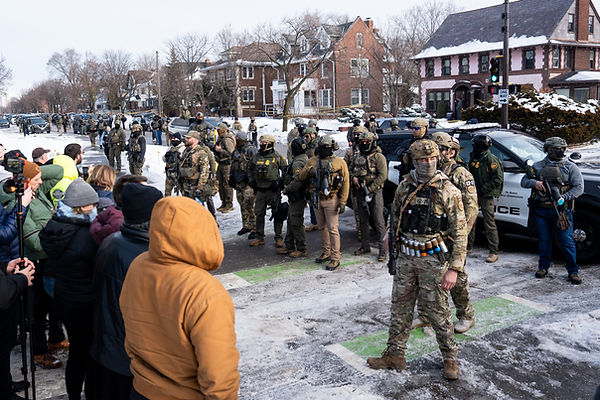
ICE agents and bystanders in Minneapolis after the Jan. 7, 2026 shooting of Renée Good (Chad Davis, https://chaddavis.photography/sets/ice-in-minneapolis/; CC BY 4.0, https://creativecommons.org/licenses/by/4.0/deed.en)
A cold winter day in South Minneapolis serves as the latest flashpoint in a national struggle over law enforcement, borders, protection, and partisan politics. The images are now fixed in the public consciousness: Alex Pretti harassing ICE officers, kicking a vehicle taillight out, taunting agents to engage, and then, a few days later, again intervening in an ICE operation, protesters filming, and gunshots ringing out resulting in his death. This event does not occur in a vacuum. It follows the recent death of another protestor, Renée Good, where an angry crowd, a maroon Honda Pilot, and a fatal round of gunfire amid screams remain seared into the collective memory. As the news cycle spins, opinions and speculation become narrative.
In this climate, we must recognize that public figures and journalists often report on fast-moving events based on staff briefings and news wires rather than firsthand accounts. Whether the reports come from President Donald Trump, NBC News, Former Homeland Security Secretary Kristi Noem, or local officials like Mayor Jacob Frey, the information is often a relay of secondary briefings. Consequently, the believer must exercise a disciplined skepticism toward all secular narratives, refusing to exchange a Biblical standard for a partisan one. This is not a call for moral neutrality, but for a high-stakes objectivity that ensures our conclusions are anchored in verified truth rather than the emotive currents of political tribalism.
Operation Metro Surge: A City on the Edge
The events in South Minneapolis represent the collision of two starkly different American realities. Since the launch of Operation Metro Surge in late 2025, the Twin Cities have seen a massive influx of federal agents, estimated at over 3,000 personnel, marking one of the largest interior immigration deployments in U.S. history. For many on the political Right, this is a long-overdue restoration of the rule of law; they point to a dramatic decrease in community safety, large amounts of illegal immigration, and an uptick in heinous crimes as evidence of a "lawless" environment fostered by sanctuary city policies and liberal policies. Conversely, the political Left views this as a "military occupation," citing the deaths of U.S. citizens Renee Good and Alex Pretti as proof of federal overreach and a "crisis of legitimacy." This polarization is exacerbated by a modern media landscape that thrives on sensationalism, following a historical precedent of dramatic escalation that stretches back to the era of Hearst and the birth of "yellow journalism." These outlets capitalize on public tension to drive engagement, intentionally fueling a cycle of conflict to maintain their viewership, even at the cost of national stability. Strikingly, that same cycle of conflict between the "oppressors" and the "oppressed" is the crux of the statist ideology, Marxism, which, unsurprisingly, has seen a massive surge in recent years as tensions increase. While some outlets highlight personal stories of those killed by "terrorists" entering the nation illegally to validate their narrative, others focus on images of masked, tactical teams in residential neighborhoods to amplify a narrative of "state-sponsored terror."
This media-driven fear has left the U.S. nation in a state of paralysis and disfunction, as evidenced even by frequent threats of a total government shutdown. Recent polling indicates that many Americans believe current immigration policy is on the "wrong track," and among immigrant communities, many others report a constant fear that they or a family member will be detained, a sentiment that has seen exponential growth since 2023. This anxiety is not limited to those in the country without permission; 31% of naturalized citizens now express fear of status revocation.
(Schumacher, Valdes, Montalvo, Hamel, Artiga, Pillai, & Kirzinger. (2025, November 18). KFF/New York Times 2025 survey of immigrants: Worries and experiences amid increased immigration enforcement. KFF. https://www.kff.org/racial-equity-and-health-policy/kff-new-york-times-2025-survey-of-immigrants-worries-and-experiences-amid-increased-immigration-enforcement/)
And still, the media news cycle continues to stoke fear and looks for ways to give credence to these fears to drive their audience numbers even higher as residents panic. Despite this, the current administration has largely refrained from acknowledging these civilian fears, instead doubling down on rhetoric of "Retribution" and "Reckoning," framing the operation as a non-negotiable necessity for national survival. The result is a cycle of escalation: local officials refuse to cooperate, federal agents increase their footprint to compensate, and civilians trapped between a perceived fascist "Gestapo" and socialist "anarchy."
Subjection to the Civil Magistrate
For the Christian believer, these undeniably tragic events and subsequent panic, misinformation, and media spin demand an evaluation through a lens that is neither partisan nor reactionary, but strictly Biblical. The Bible establishes that the State is not a human invention but a divine ordinance. According to Romans 13:1, "Every person is to be in subjection to the governing authorities. For there is no authority except from God, and those which exist have been appointed by God." The apostle Paul made no mention of protest or overthrow as he wrote Romans. Instead, he specifically wrote that the civil magistrate is the servant of God, an avenger who carries out God’s wrath on the wrongdoer (see Romans 13:4). Paul stated that this authority is delegated for the specific purpose of maintaining order and punishing evil. From a contextually Biblical lens, we see that, even today, amidst all the context of immigration and national borders, the State possesses a clear jurisdiction to rule. Scripture does not command revolution, anarchy, or borderless nations. Instead, it affirms the necessity of law to restrain the effects of the Fall.
When federal agents engage in a targeted operation, they act within the sphere of authority ordained by God to preserve civic order. A society that ignores minor violations or allows its borders to be bypassed eventually loses the capacity to enforce even fundamental laws such as those against murder, theft, and others from creation order. From a law enforcement level, the magnitude of a crime does not change the nature of the rebellion against order. To that effect, things such as immigration statute enforcement are a matter of civil obedience. The magistrate does not bear the sword in vain. The Christian’s primary response to the State is one of subjection, recognizing that the rule of law is a manifestation of common grace that protects all citizens. As 1 Peter 2:13-14 states, "Be subject for the Lord's sake to every human institution, whether it be to the emperor as supreme, or to governors as sent by him to punish those who do evil and to praise those who do good." Should the current administration transition from a legitimate civil magistracy into a regime of systemic persecution, the Christian’s position would simply mirror that of the early church under Emperor Nero. This historical parallel reminds us that the Apostle Paul penned his instructions on subjection to authority amid a time of significant state-sanctioned hostility toward the faith by the Greek Emperor Nero who was killing fellow believers at an extreme rate. Yet Paul made no mention of rebellion or revolution. Consequently, if the government abdicates its role as a "minister of God for good", the believer’s duty to obey God above man remains the steadfast Biblical precedent. This subjection is never a declaration of the State's ultimate supremacy, but an acknowledgement of its delegated authority. Because we hold to the absolute Lordship of Christ, we recognize that Jesus is the only Despotēs, the Master to whom every knee must eventually bow. If the State exceeds its jurisdiction by forbidding what God has commanded, our higher loyalty to the Kingdom of God must prevail, for our conscience is captive to the Word of God, not the mandates of men.
The Principle of National Preservation
Critics of the ongoing ICE operations and other federal action recently have pointed to procedural inconsistencies or instances of overreach stating that broken immigration law cannot be fixed by breaking the law in other places. However, to that end, the concept of national preservation suggests a strict adherence to every detail of written law must not result in the destruction of the nation itself. In a hearkening to one of the U.S founding fathers, Thomas Jefferson addressed this in 1810, writing:
A strict observance of the written laws is doubtless one of the high duties of a good citizen, but it is not the highest. The laws of necessity, of self-preservation, of saving our country when in danger, are of higher obligation. To lose our country by a scrupulous adherence to written law, would be to lose the law itself, with life, liberty, property and all those who are enjoying them with us; thus absurdly sacrificing the end to the means.
(Jefferson, Thomas Jefferson to John B. Colvin: Article 2, Section 3. https://press-pubs.uchicago.edu/founders/documents/a2_3s8.html)
In 2026, the administration views the current border situation as a crisis of national survival. While a citizen's sensibilities and daily habits must remain vigilant towards actual tyranny, it is necessary to consider whether the State is operating under this Jeffersonian principle of necessity. If the government perceives an existential threat to the stability of the Republic, its actions are directed toward the restoration of a lawful society. To lose the country by refusing to act against chaos is to lose the law itself. As seems to have been evidenced already, the current Trump administration operates under the belief that fixing a broken system requires a period of "extreme pain" to secure long-term stability and economic growth and can justify some overreach in order to bring things into, what it sees as, national security & stability. The future will reveal whether these fringe measures are justified by necessity or if they establish dangerous precedents that remain unyielded, ultimately facilitating the rise of a pervasive and oppressive regime. In this tension, the Christian must remember that while the state navigates political necessity, prudence must never supersede truth. We cannot afford to dilute God’s objective standards of justice today in a desperate attempt to secure our own religious liberty or national safety tomorrow. Our trust remains in the sovereignty of God, not in the "strategic safeguarding" of our rights through the compromise of our convictions.
Individual Mercy and Civic Order
A frequent point of tension in the current discourse involves the blurring of the Church’s spiritual mission with the State’s judicial duty. The opposing view often suggests that because Jesus ate with sinners and the Apostles practiced civil disobedience, the State should exercise a form of "universal mercy" that effectively ignores legal status. While this sentiment often springs from a place of genuine compassion, it creates a theological and practical category error by ignoring the three distinct spheres of authority God has ordained: the Family, the Church, and the State. Each possesses a specific jurisdiction, and the health of a society depends on none being subsumed under the other (especially not the State subsuming the other two).
In our personal lives, the Christian is called to a ministry of reconciliation. When a Christian encounters a neighbor who lacks legal status, the Christian ought not to see a "political problem"; rather, he or she should see an image-bearer of God (Genesis 1:27) who is in need of the hope found only in Christ. The priority is then individual mercy, which involves offering hospitality and sharing the Gospel. This mandate focuses on the eternal state of the soul which can only be rescued by the Gospel. Conversely, the State is not a minister of the Gospel; it is a minister of justice (Romans 13:4). Simultaneously, the Christian functions as a citizen with a responsibility to obey State’s enforcement of its statutes. A stable and lawful society provides the security necessary for all people to thrive which is, in itself, a tangible expression of love for the broader community. Consequently, the believer ministers to a neighbor’s spiritual needs with a tender heart while simultaneously recognizing that a violation of civil law constitutes a rebellion against the order God has established for human flourishing.
The Limits of Submission and the Necessity of Action
The obligation to the State remains binding unless the magistrate abdicates its divine role by intentionally targeting the guiltless, as seen in the moral necessity of those who shielded Jewish families from Nazi persecution. Scripture provides a clear limit to the State’s authority. As noted in Acts 5:29, "We must obey God rather than men." If the State’s sword is misused to intentionally destroy those who are legally guiltless, the Christian’s higher loyalty to the Kingdom of God prevails. This is seen in the example of the Hebrew midwives who defied Pharaoh (Exodus 1). When man’s law demands an "extreme inversion of justice" and requires a violation of the "weightier matters of the law" (Matthew 23:23), defiance is a duty. In WWII, the Nazi State’s law was used to hunt a people based solely on their race, an act that fundamentally violated the Biblical definition of justice and transformed the magistrate from a servant of God into a minister of evil. In such extreme inversions of justice, the Christian must appeal to the higher authority of Acts 5:29, choosing to preserve innocent human life over a statute that has ceased to reflect God’s delegated purpose for the civil sphere.
Could we see a repeat of WWII's atrocities among a new people group? It is certainly possible. However, it is important to note that, as things stand right now, the parallels are not the same and those in this country illegally have committed crimes against the nation which do require rectifying in order to maintain order for the citizens that the government is sworn to protect first and foremost.
The vital distinction lies in the difference between ontology and action. The atrocities of the mid-20th century targeted the Jewish people for their being, their race and ethnicity, which is an assault on the Image of God. Current enforcement, however, addresses action, the specific rebellion against established order and the illegal bypassing of a nation's gates. To conflate the two is to ignore the Biblical definition of justice, which judges a man for his deeds rather than his origin.
A Nation without Laws is No Nation At All
Common sense informs us that, just as a house requires a door to function as a home, a nation requires a border to function as a sovereign state. Advocacy for a secure border is not an anti-immigrant stance; it is a pro-order stance. Because the nation provides legal ports of entry and established channels, illegal behavior is never a necessity for those legitimately seeking to enter for good. In the book of Acts, the apostles' refusal to stop preaching (Acts 5:29) & Peter’s miraculous escape from jail (Acts 12) are often used as a "divine license" for general law-breaking. Yet, there is a vital distinction to be made: the Apostles disobeyed only when the State commanded them to stop fulfilling the Great Commission. They were choosing to "obey God rather than men" because the State had exceeded its jurisdiction by forbidding what God had explicitly commanded. In contrast, the Bible contains no command requiring individuals to enter a sovereign nation in violation of its laws, nor does it forbid a nation from regulating its gates. Since following immigration law does not require a believer to sin against God, it remains a matter of civil obedience.
Christians are called to "walk in wisdom toward outsiders, redeeming the time" (Colossians 4:5) and to be the most peaceable of citizens, recognizing that the "rule of law" is a manifestation of common grace that protects the vulnerable from the chaos of the unrestrained.
Addressing the Charges of Racial Profiling
As the situation in Minneapolis increases and protests break out among groups of people in other areas, many contend that current enforcement actions are rooted in racial profiling or a desire to establish a white-supremacist nation. They try to draw comparisons of the Nazis targeting Jews and ICE targeting illegal immigrants stating they are one and the same. This charge relies on rhetorical hyperbole rather than empirical evidence. In the realm of law enforcement, visual descriptors are mandatory and indispensable tools for identification. What appears as profiling to a casual onlooker is often a standard investigation based on specific leads or descriptions of suspects, such as "Hispanic male, age 40."
Furthermore, applying the label of "white supremacy" to standard immigration enforcement is a form of linguistic injustice. It diminishes the severity of the term and ignores the fact that, again, a secure border is a standard policy for any sovereign nation. This is because the civil magistrate is not a compromising arbiter of right and wrong, but a minister accountable to God’s objective right; His moral standards. We reject the idea that the State should operate in a vacuum of 'moral neutrality.' Instead, the government’s duty is to reflect the creation order, an objective reality where distinction, boundaries, and the rule of law are essential for a society to flourish under God’s providential care. In a strange twist, using such a label for standard policy does a disservice to the victims of real racism and causes the label to lose its power (think of the little boy who cried 'wolf!'). While bad actors may exist within ICE and any other system, there is no factual basis to conclude that the current administration as a whole is attempting to create a racial state. Simultaneously, much of the media landscape further compounds public anxiety by intentionally blurring the distinction between legal residency and illegal status, fostering a narrative that the State is targeting all immigrants because of a perceived dislike of another skin pigmentation. In reality, enforcement actions focus on those who bypass established legal channels. Additionally, many incidents labeled as "unjust force" are actually the necessary remediation of obstruction. When individuals interfere with law enforcement duties by violating secured perimeters or physically hindering agents, they invite lawful intervention. In any era of law enforcement, such interference leads to attention, arrest, and occasionally, far more, as a grave matter of public order.
The Dangers of Syncretism and Carte Blanche Support
We have touched on the potentials of misuse of power, universal corruption, and the repeat of historical atrocities by those currently in power or those in future. In the same manner, it is important to note that while the Christian supports the State’s role in maintaining order, this is not a grant of "carte blanche" support to any leader or party. Granting unconditional loyalty to a man or an agenda is how religious and political cults are formed. This is very dangerous and it is how many evil leaders in history have risen to extreme power and done much damage. Rather, the believer evaluates individual actions as "hits" or "misses" based on the Word of God. A wish in the form of a vote for a leader is not worship of that leader; it is a stewardship of the civil sphere in a fallen world in which, in some nations, we are permitted to cast a ballot. For many, a vote is a pragmatic choice to restrain greater evils on the other side, such as the "pro-death culture" of abortion.
Further, when immersed in Scripture, a Christian will overtly reject such movements as true Christian Nationalism and the Reconstructionism movement because the concept of a modern earthly theocracy is simply not found in the New Testament. Likewise, there must be a firm opposition among believers to Dominionism and the "7-mountain" mandate, viewing them as forms of syncretism, a mixing of Christ’s spiritual kingdom with the love of worldly power.
In the interest of clarity, however, Christian Nationalism has been a term that is too broadly used and not well-enough defined in today's media sphere. In an interview with Jonny Ardavanis recently, Alisa Childers stated that the sentiment from many today is, "if you have a more conservative view, then you're automatically a 'Christian Nationalist.'" Jonny agreed and replied that Christian Nationalism has become a 'boogeyman term'. This has been shown to be true by countless periodicals and the ongoing fear mongering among media outlets. Alisa Childers went on to state, "the primary expression of 'Christian Nationalism' is just a slur that people will say against you if you're a Christian and you're trying to advocate in the public square and you're not left." (Ardavanis & Childers, Alisa Childers on Progressive Christianity, Deconstruction & Defending Your Faith 2025)
Conclusion: Fidelity to Christ in a Fragmented Republic
The glory of God is witnessed through common grace whether a civil official seeks to uphold order and restrain chaos or a non-believer demonstrates a natural affection and moral restraint that facilitates the survival of others in the community. This divine benevolence is reflected in 1 Timothy 4:10, which describes God as the "Savior of all men, especially of those who believe," implying a temporal, preserving mercy that allows human society to persist. This benevolence extends directly to the civil sphere, informing our duty to pray for all leaders, whether their policies align with our preferences or not, as commanded in 1 Timothy 2:1-2. The objective of such prayer is not political triumph, but that the State might possess the wisdom to leave the Church unhindered in its mission to preach the Gospel. When the magistrate fulfills its delegated role, the believer is enabled to lead a "quiet and peaceable life in all godliness and honesty" (1 Timothy 2:2).
The convictions expressed regarding the Minneapolis incidents and the current administration are not "hot takes" born of partisan spirit or the defense of a ballot cast. Rather, they are individual threads of a singular, consistent Biblical fabric anchored in the absolute Lordship of Jesus Christ. Whether one views the current federal actions as a necessary restoration of law or a dangerous precedent of overreach, the Christian’s conscience must remain captive to the Word of God alone. While we navigate the "extreme pain" of national restructuring and the tragedies of the Minneapolis streets, we refuse to let a single news cycle or a secular narrative define our entire worldview. We wait for the facts with sobriety, we pray for our leaders with sincerity, and we hold fast to the exclusivity of Christ and the sufficiency of His Word. In a world of shifting political sands, the believer’s highest allegiance is not to a flag, a party, or a president, but to the King whose throne is never contingent on a human vote.